
Stop Starting With Your Product: Why 99% of Filipino Entrepreneurs Build Backwards (And How to Fix It)
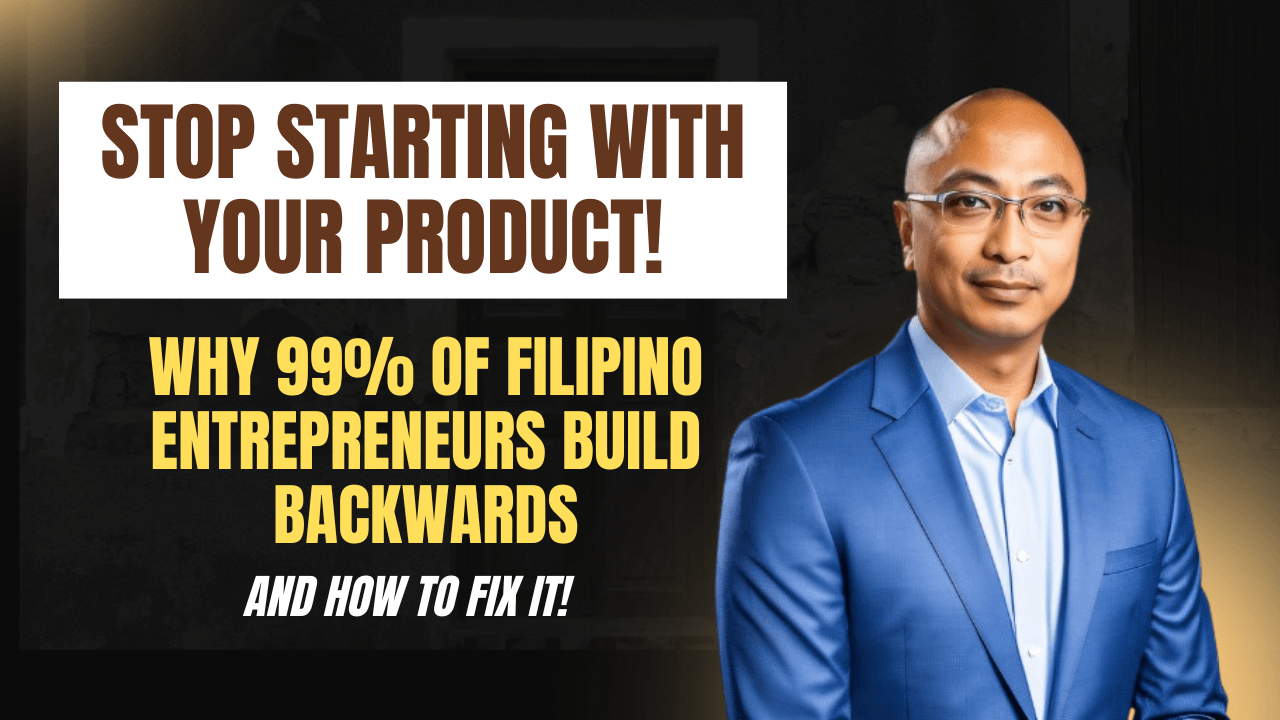
Most Filipino entrepreneurs wake up with a brilliant product idea, spend months building it using their OFW savings or family money, launch to crickets, and wonder why their "game-changing" innovation isn't gaining traction in the Philippine market. If this sounds familiar, you're not alone—and you're not broken. You're just starting from the wrong place entirely.
After analyzing hundreds of successful exits across Southeast Asia and working with Filipino founders who've built ₱5 billion+ companies, I've discovered a counterintuitive truth: the most successful Filipino entrepreneurs don't start with their product. They start with their endgame and reverse-engineer everything backward—from Ayala Avenue to Silicon Valley.
This isn't another feel-good entrepreneurship article filled with motivational quotes. This is a systematic breakdown of why traditional startup advice is failing Filipino entrepreneurs and the exact methodology that separates real negosyante from serial strugglers in our competitive market.
Table of Contents
The ₱500 Million Mistake Most Filipino Entrepreneurs Make
Here's the brutal truth: 99% of Filipino entrepreneurs are building their businesses completely backwards. They start by asking, "Anong pwedeng ibenta?" while ₱5 billion founders ask a fundamentally different question that changes everything.
The typical Filipino entrepreneur journey looks like this:
Get excited about a product idea (often inspired by successful foreign businesses)
Build the product using personal savings, family support, or OFW remittances
Try to find Filipino customers in Metro Manila, Cebu, or Davao
Struggle with revenue and cash flow in the Philippine market
Pivot to different regions or quit entirely
This approach has a 90% failure rate in the Philippines, yet it's what every local startup accelerator, business course at Ateneo or La Salle, and entrepreneurship guru teaches. Why? Because it feels logical. It feels safe. It feels like "building something."
But here's what successful Filipino founders actually do: they start with their exit strategy—whether it's acquisition by Globe, Ayala Corporation, or foreign investors—and work backwards to the product. They define their endgame first, then reverse-engineer every decision to serve that ultimate objective.
Why Traditional Startup Advice Doesn't Work in the Philippines
The startup ecosystem is built on a fundamental lie: that passionate Filipino founders with great products automatically succeed in our market. This advice sounds inspiring, but it's statistically wrong in the Philippine context.
The Passion Trap in Filipino Culture
"Follow your passion" is probably the worst business advice ever given to Filipino entrepreneurs. While passion is valued in our culture, it doesn't create sustainable businesses in the Philippines—market demand does. When you start with passion, you're essentially betting that Filipino consumers will conform to your interests. That's not negosyo; that's wishful thinking.
The Product-First Fallacy in the Philippine Market
Traditional advice tells you to build an MVP, get feedback from Filipino users, and iterate. But this assumes you're solving a problem that Filipinos actually want solved and are willing to pay for with their hard-earned pesos. Most Filipino entrepreneurs spend months perfecting solutions to problems that don't exist in our local market or aren't urgent enough to drive purchasing decisions among price-conscious Filipino consumers.
The Revenue Ceiling Reality for Filipino Startups
Product-first Filipino entrepreneurs typically hit revenue ceilings between ₱5M-₱50M annually. Why? Because they've built businesses around their capabilities rather than Philippine market opportunities. They've optimized for what they can build, not what Filipino customers actually want to buy.
The Reverse-Engineering Method: How ₱5 Billion Filipino Founders Really Think
₱5 billion Filipino founders don't start with products—they start with outcomes that make sense in the Philippine economic landscape. They ask different questions:
"What does a ₱5 billion business in the Philippines look like?"
"Which Filipino customers or market segments have the most urgent, expensive problems?"
"What would need to be true for this to scale across the archipelago?"
"What's the path from serving Metro Manila to serving all of Southeast Asia?"
This isn't about dreaming big—it's about strategic thinking adapted to Philippine realities. They're reverse-engineering success from the endpoint, not forward-engineering from their current capabilities or limited understanding of the local market.
The Mindset Shift for Filipino Entrepreneurs
Instead of asking "Ano kaya pwedeng gawin?" successful Filipino founders ask "Ano dapat maging available sa market?" They're Philippine-market-first, not product-first. They identify massive opportunities within the Filipino consumer base and broader ASEAN market, then figure out how to serve them—not the other way around.
The 5-Step Reverse-Engineering Framework for Philippine Success
Here's the exact methodology that ₱5 billion Filipino founders use to build scalable companies that can compete regionally and globally:
Step 1: Define Your Philippine Endgame
Start with your ultimate exit scenario within the Philippine business ecosystem. Not your product, not your passion—your endgame. Ask yourself:
What does success look like in 7-10 years in the Philippines?
Who would acquire this business for ₱5B+? (Ayala, SM Group, JG Summit, foreign investors, IPO on PSE)
What would make this business irreplaceable in the Philippine market?
What market size in the Philippines and ASEAN would support this valuation?
Write this down. Be specific. "Gusto kong maging successful na entrepreneur" isn't an endgame—it's a wish.
"I want to build the leading fintech platform for Filipino OFWs and their families, and sell to UnionBank or BDO for ₱10 billion" is an endgame.
Step 2: Identify the Philippine Market Opportunity
Work backwards from your endgame to identify the market opportunity that supports it within the Philippine economic context. This isn't about market research—it's about Philippine market math.
What's the total addressable market in the Philippines and ASEAN?
What market share would you need among Filipino consumers for your target valuation?
Who are the existing players (Globe, Smart, Jollibee, etc.), and where are the gaps?
What trends in Philippine consumer behavior, technology adoption, or economic development are creating new opportunities?
If the math doesn't work with Philippine purchasing power and market dynamics, change your endgame or find a different market. Don't fall in love with markets that can't support your ambitions within our economic reality.
Step 3: Map the Filipino Customer Journey
Identify your ideal customer profile by working backwards from your endgame, considering unique Filipino characteristics:
Who has the most urgent, expensive problems in the Philippine market?
Who has the biggest budget for solutions? (Corporations in BGC, successful OFWs, growing middle class, etc.)
Who makes decisions quickly in Filipino business culture?
Who values outcomes over price? (Understanding Filipino price sensitivity vs. value perception)
Don't assume you know who your Filipino customers are. Research obsessively. Talk to potential customers from Luzon to Mindanao before you build anything. Understand their pain points, decision-making processes influenced by Filipino culture, and success metrics relevant to their Philippine context.
Step 4: Design the Business Model for Philippine Market
Now—and only now—design your business model adapted to Philippine economics and consumer behavior. Work backwards from your revenue targets:
What's your target revenue per Filipino customer? (Consider purchasing power and spending patterns)
How many customers do you need across the archipelago?
What's your pricing strategy for price-sensitive Filipino consumers?
What's your customer acquisition cost in the Philippine market?
(Factor in digital literacy, social media usage, word-of-mouth culture)What's your lifetime value considering Filipino customer loyalty patterns?
Your business model should be a direct path to your endgame while working within Philippine market constraints and opportunities.
Step 5: Build the Minimum Viable Solution for Filipinos
Finally, build the minimum viable solution that serves your business model and works effectively for Filipino users. Notice I didn't say "product"—I said "solution."
Sometimes the solution for the Philippine market is a product.
Sometimes it's a service.
Sometimes it's a platform adapted to Filipino internet infrastructure. Sometimes it's a combination that accounts for regional differences across the Philippines.
The key is building only what's necessary to validate your business model with Filipino customers and start generating peso revenue. Everything else is waste in our resource-constrained environment.
Case Study: From ₱10M to ₱10B Exit Using This Method
Let me share a real example of how this method works in practice with a Filipino entrepreneur.
The Traditional Approach (What Didn't Work)
Miguel Santos started his first company in 2016 with a brilliant idea: a logistics management tool for sari-sari stores. He was passionate about helping local entrepreneurs, had grown up in a family of store owners in Quezon City, and knew the pain points intimately.
He spent 18 months building the perfect product using his savings from working in Singapore, raised ₱25 million in seed funding from local angel investors, and launched to modest success. But after three years, he plateaued at ₱10 million annual revenue. He had passionate customers but couldn't scale beyond Metro Manila's neighborhood stores.
The Reverse-Engineering Approach (What Worked)
In 2019, Miguel pivoted using the reverse-engineering method:
Step 1: Philippine Endgame Definition Instead of "building a great tool for sari-sari stores," Miguel defined his endgame: "Build the leading supply chain digitization platform for Filipino SMEs and sell to Ayala Corporation or Globe for ₱10 billion within 7 years."
Step 2: Philippine Market Opportunity He identified that Filipino SMEs spend ₱2 trillion annually on supply chain management, with 78% reporting that poor inventory management costs them ₱500K+ annually in lost sales opportunities.
Step 3: Filipino Customer Journey Instead of targeting individual sari-sari stores, he focused on Filipino SME chains, distributors, and suppliers with ₱50M+ revenue who needed compliance, integration, and analytics capabilities that neighborhood stores didn't require.
Step 4: Philippine Business Model He shifted from a ₱1,500/month SaaS model to a ₱2.5M+ annual enterprise contract model with implementation services tailored to Filipino business practices.
Step 5: Minimum Viable Solution for Philippine Market He rebuilt his platform specifically for Filipino enterprise needs: integration with local banks (BPI, BDO, Metrobank), compliance with BIR requirements, and mobile-first design for Filipino management teams.
The Results
By 2023, Miguel's company was generating ₱750 million annually. In 2024, he sold for ₱9 billion—a 360x return on his pivot decision and one of the largest Filipino tech exits to date.
The difference? He stopped building what he wanted to build and started building what needed to exist to reach his endgame within the Philippine market context.
The Endgame Test That Changes Everything for Filipino Entrepreneurs
Before you make any major business decision, run it through the endgame test adapted for Philippine business realities:
Does this decision move me closer to my endgame within the Philippine market?
If I'm successful with this decision, does it create the foundation for expanding across ASEAN?
Does this decision serve my target Filipino customers' most urgent problems?
Does this decision support my business model economics given Philippine purchasing power?
If you can't answer "yes" to all four questions, reconsider the decision. This simple test will save you months of wasted effort and hundreds of thousands of pesos in opportunity cost.
Implementation: How to Apply This to Your Philippine Business Today
Whether you're just starting or stuck at your current revenue level in the Philippine market, here's how to implement this methodology:
For Pre-Launch Filipino Entrepreneurs
Stop building immediately (unless you're weeks from launch to Filipino customers)
Define your Philippine endgame using the framework above
Research your Philippine market opportunity thoroughly, including regional variations
Validate your Filipino customer profile through direct conversations across different socioeconomic segments
Design your business model to support your endgame while working within Philippine economic realities
Build only what's necessary to validate your model with Filipino users
For Existing Philippine Businesses
Audit your current trajectory against your endgame within the Philippine and ASEAN context
Identify the gaps between where you are and where you need to be to succeed regionally
Prioritize changes that close the biggest gaps first while maintaining cash flow
Test new approaches with small experiments in different Philippine regions
Scale what works across the archipelago and eliminate what doesn't
For Stuck Filipino Entrepreneurs
If you're stuck at the same revenue level, you probably have a Philippine business model problem, not a product problem. Use this method to identify whether you need to:
Change your target market (from B2C to B2B, or from local to regional)
Adjust your pricing model for Filipino purchasing power
Modify your product positioning for Philippine cultural preferences
Pivot your entire approach to better serve ASEAN opportunities
Common Pitfalls Filipino Entrepreneurs Face and How to Avoid Them
Pitfall 1: Confusing Endgame with Vision in Filipino Culture
Your endgame isn't your vision or mission—it's your specific, measurable exit strategy within the Philippine business ecosystem. "Helping Filipino families" isn't an endgame. "Building a ₱5 billion business that helps Filipino families and gets acquired by BDO Unibank" is an endgame.
Pitfall 2: Choosing Unrealistic Endgames for Philippine Market
Your endgame should be ambitious but achievable within Philippine economic realities. If you're a first-time Filipino founder targeting a ₱500 billion exit in a ₱250 billion Philippine market, you're setting yourself up for failure.
Pitfall 3: Ignoring Philippine Market Dynamics
Just because you can envision an endgame doesn't mean the Philippine market will support it. Do the peso math. Validate the opportunity with Filipino consumers. Don't let optimism override analysis of local purchasing power and cultural preferences.
Pitfall 4: Skipping Filipino Customer Validation
Reverse-engineering isn't about assuming what Filipino customers want—it's about systematically discovering what they need and building toward that outcome while respecting cultural nuances and economic constraints.
Pitfall 5: Underestimating Regional Differences in the Philippines
What works in Metro Manila might not work in Cebu, Davao, or rural provinces. Factor in regional economic differences, cultural variations, and infrastructure limitations when planning your endgame.
Frequently Asked Questions
Q: Isn't this approach too focused on money instead of helping Filipino communities?
A: Impact requires sustainability in the Philippine context. A business that fails helps no Filipino family or community. By reverse-engineering from a viable endgame, you're building something that can create lasting positive impact for Filipino society.
Q: What if I don't want to sell my business to a large Filipino corporation? A: Your endgame doesn't have to be acquisition by Ayala or SM Group. It could be reaching a certain revenue level, going public on the Philippine Stock Exchange, creating a family legacy business, or expanding across ASEAN. The key is defining a specific, measurable outcome.
Q: How do I know if my endgame is realistic in the Philippine market?
A: Research comparable Filipino companies and regional successes. Look at recent acquisitions, PSE valuations, and growth trajectories of Philippine businesses. If similar companies have achieved your endgame, it's likely realistic.
Q: Can this method work for service businesses in the Philippines?
A: Absolutely. Service businesses can be scaled and sold just like product businesses in the Philippines. The key is building systems and processes that don't depend entirely on the founder and can work across different Philippine regions.
Q: What if I'm passionate about serving underserved Filipino communities?
A: Passion is valuable in Filipino culture, but it should serve your endgame, not drive it. Ask yourself: "Can my passion support a business model that leads to my endgame while truly helping Filipino communities at scale?" If not, find a different application for your passion that can achieve both social impact and financial sustainability.
Q: How do I handle family pressure to start earning immediately instead of planning long-term?
A: Show your family the reverse-engineering method and potential outcomes. Explain that taking time to plan properly increases the chances of supporting the family more substantially in the future. Consider setting milestones that provide some immediate income while building toward your endgame.
The Bottom Line: Start With the End in Mind for Philippine Success
The difference between successful Filipino entrepreneurs and everyone else isn't talent, luck, or family connections—it's methodology adapted to Philippine realities. While 99% of Filipino entrepreneurs are building forward from their current capabilities, the 1% who succeed are building backward from their endgame while understanding local market dynamics.
This reverse-engineering approach isn't just about building bigger businesses—it's about building the right businesses for the Philippine market and beyond. It's about creating companies that can scale across the archipelago, attract top Filipino talent, secure funding from local and international investors, and ultimately achieve the outcomes you're dreaming about for your family and community.
Stop starting with your product. Start with your Philippine endgame. Everything else is just tactics.
Ready to reverse-engineer your path to Filipino entrepreneurial success?
Start by defining your endgame today within the Philippine business ecosystem. Write it down. Make it specific. Make it measurable. Factor in Philippine market realities. Then work backwards to identify the market opportunity, Filipino customer profile, business model, and minimum viable solution that will get you there.
The Filipino entrepreneurs who figure this out don't just build businesses—they build legacies that transform Philippine communities and compete on the global stage. Which one will you be?
Take the Next Step in Your Entrepreneurial Journey
If you found this guide helpful and want to dive deeper into topics like fundraising, share issuance, incorporating your business, or preparing for an IPO, don't miss out on future insights and expert advice.
Join our email list to receive exclusive content tailored to empowering SMEs like yours. Stay ahead with the latest strategies in capital entrepreneurship and build a supportive community of like-minded business owners.
Follow us on our social media pages for daily tips, inspirational stories, and up-to-date industry news! Your growth is our mission.
Follow Us on Facebook: Facebook Page
Connect on LinkedIn: LinkedIn Profile
Follow Us on X (Twitter): Twitter Handle
Check Me out on Instagram:Instagram Profile
Listen to my Podcast on Spotify:Listen Here
Together, let's build your business to new heights with confidence and optimism!
Join My FREE Webinar:

Don't let uncertainty hold you back - Transform your entrepreneurial ideas into profitable reality!
Get the World’s Easiest All-In-One Marketing Platform

Host your websites, create sales funnels, send marketing emails, and more all under a single, easy-to-use platform. Best of all... It's FREE!

Are you planning to do fundraising for your business venture?
This Fundraising CRM will help you keep track of your fundraising rounds and investor details so that you maximize your chances of raising your target capital!
Easy to use and access anywhere via Google Sheets!
How-to-use tutorial with step-by-step instructions by Lou Beltran
Simple yet powerful! Never underestimate its simplicity.
We hate spam! Your details are 100% safe with us.
Copyright © 2023
LouBeltran.com &
Samvinna Management
All Rights Reserved
Let's Connect


itsreallyme@loubeltran.com
©LouBeltran.com. All Rights Reserved 2022. LouBeltran.com is a product of Samvinna Management. You should assume that products that I recommend (books, movies, etc.) This may result in compensation paid to me Lou Beltran by the sellers I recommend. If you would rather that I not be compensated for these recommendations, go to Google search for the item, and find a non-affiliate link to use. You should perform your own due diligence and use your own best judgment prior to making any investment decision. You are fully responsible for the purchases you make and any outcomes that may result from your purchase.