
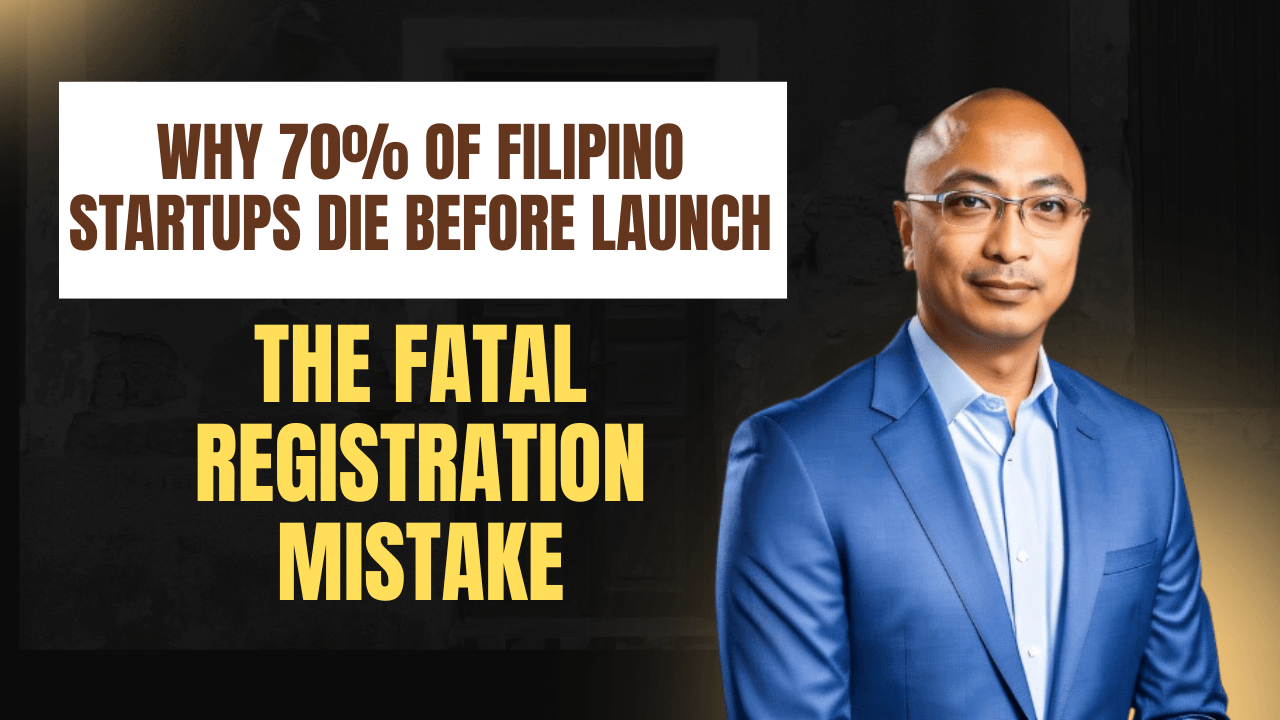
Why 70% of Filipino Startups Die Before Launch: The Fatal Registration Mistake
Picture this: You've got a brilliant business idea that could be the next big thing in the Philippines. You're excited, motivated, and ready to become the next entrepreneurial success story like the founders of Jollibee, Bench, or Grab Philippines. So what do you do first? If you're like most aspiring Filipino entrepreneurs, you rush to register your business with DTI or SEC, create a catchy company name, maybe even design a logo. After all, that's what makes it "official," right?
Mali. Sobrang mali.
And this single mistake is quietly killing 70% of Filipino startups before they even have a chance to compete in our growing economy.
I've spent 20 years in the startup ecosystem across Southeast Asia, launched multiple ventures, and analyzed thousands of businesses from Makati to Cebu to Davao. The pattern is always the same: Filipino entrepreneurs who prioritize government paperwork over market validation are setting themselves up for expensive, heartbreaking failure. Today, I'm going to show you exactly why this happens and how to avoid becoming another casualty in the Philippine startup graveyard.
Table of Contents
The Hidden Registration Trap That's Destroying Filipino Startups
The Psychological Trap of "Making It Official"
When you register a business in the Philippines, something powerful happens psychologically. You feel legitimate. You feel committed. You feel like you're "really doing this." But here's the brutal truth: DTI registration is a checkpoint, not a starting line.
The registration trap works especially hard on Filipino entrepreneurs because of our cultural relationship with authority and official processes:
False Sense of Progress: Registration feels like meaningful progress, but it's actually just administrative work
Sunk Cost Fallacy: Once you've invested time and money in DTI registration, Mayor's permit, BIR registration, and SSS setup, you're psychologically committed to pushing forward even when you shouldn't
Resource Drain: Registration costs, legal fees, and ongoing compliance requirements (hello, monthly BIR filings!) drain precious resources that should be used for validation
Premature Optimization: You start optimizing for Philippine business structure requirements before knowing if you have a viable business
The Real Numbers Behind Filipino Startup Failure
Recent studies from the Department of Trade and Industry show that 70% of registered Filipino startups fail before they even launch their first product or service. Notice I said "before launch" – these aren't businesses that tried and failed in the Philippine market. These are businesses that died during the preparation phase.
The primary culprit? Lack of proper market validation in the Filipino context.
When Filipino entrepreneurs rush to register their business, they're essentially building a bahay kubo without first checking if the foundation can withstand Philippine weather conditions. They're optimizing for bureaucratic structure when they should be optimizing for market survival.
Maria's ₱150,000 Lesson: A Real Quezon City Warning
Let me tell you about Maria, a talented OFW who returned to the Philippines with what seemed like a brilliant business idea. She came to me after losing ₱150,000 and six months of her life to the registration trap.
Maria had worked in Singapore for five years and noticed how successful meal delivery services were there. She was passionate about bringing healthy, affordable Filipino meals to busy professionals in Metro Manila. With her savings from working abroad and years of experience in food service, what could go wrong?
Maria's Fatal Sequence of Events
Week 1: Maria registered her business name with DTI, got her Mayor's permit in QC, and set up her BIR registration
Week 2: She invested in branding, logo design, and a professional website with Filipino-friendly payment options
Week 3: Started negotiating with local suppliers in Divisoria and setting up a commercial kitchen in Cubao
Week 4-12: Built out the entire operational infrastructure, hired delivery riders, and created elaborate meal plans
Week 13: Maria finally started reaching out to potential customers in Makati, BGC, and Ortigas for the first time.
The results were devastating. After talking to just 20 Filipino professionals, Maria discovered:
85% were already satisfied with existing options like Grab Food, Food Panda, or their office canteen
70% weren't willing to pay the premium for "healthy" meals when cheaper alternatives existed
60% found subscription meal plans too restrictive for Filipino eating habits (we love variety!)
90% wanted to try the food first before committing to any subscription
Maria had spent months building a business around assumptions about Filipino consumer behavior that were completely wrong. If she had validated her idea first in Makati food courts and office buildings, she would have discovered these cultural preferences in week one, not week thirteen.
What Maria Should Have Done
Instead of rushing to register, Maria should have:
Conducted customer interviews with actual Filipino office workers to understand real pain points
Tested her price point with potential customers who understand peso budgets
Validated the subscription model against Filipino dining culture and habits
Confirmed demand by selling meals manually from a cart or pop-up before investing in infrastructure
Only after proving market demand in the Philippine context should she have considered DTI registration.
The 3 Pillars of Validation Framework for Filipino Markets
After analyzing thousands of Filipino startups, I've identified three critical pillars that separate successful ventures from expensive failures in the Philippine market. Miss any one of these, and you're setting yourself up for disaster in our unique economic landscape.
Pillar 1: Filipino Market Validation
What it is: Confirming that a real, paying Filipino market exists for your solution.
How to do it in the Philippines:
Conduct 20-30 customer interviews with actual Filipinos in your target demographic
Test pricing sensitivity with people who understand peso economics and Filipino spending habits
Analyze successful Filipino competitors and understand why they work here
Validate market size considering Philippine income distribution and regional differences
Red flags to watch for in the Philippine market:
Customers say "maganda yan ah" but won't commit to paying
You can't find evidence of similar successful businesses in the Philippines
Your price point doesn't account for Filipino purchasing power
Market research shows declining demand due to economic conditions
Pillar 2: Solution Validation for Filipino Users
What it is: Proving your specific solution actually solves problems for Filipino customers.
How to do it with Filipino users:
Create minimum viable prototypes (MVPs) that work with Philippine infrastructure
Test core functionality with real Filipino users in their actual environment
Consider Filipino cultural preferences, language nuances, and user behavior
Gather feedback on user experience considering Filipino technology adoption patterns
Red flags to watch for with Filipino users:
Users can't figure out how to use your solution despite being tech-savvy
High initial engagement but rapid drop-off (common in Philippine markets)
Customers request features that would require significant cultural adaptation
Pillar 3: Philippine Business Model Validation
What it is: Confirming you can deliver your solution profitably within the Philippine business environment.
How to do it in the Philippines:
Test your pricing model considering Filipino purchasing power and payment preferences
Validate acquisition channels that work in the Philippines (social media, word-of-mouth, community-based marketing)
Confirm operational capabilities considering Philippine logistics and infrastructure
Ensure unit economics make sense with Philippine labor costs and regulatory requirements
Red flags to watch for in Philippine business models:
Customer acquisition costs are too high for Filipino lifetime values
Operational costs make profitability impossible with Philippine pricing
Revenue model doesn't align with Filipino payment behavior (cash preference, irregular income)
Regulatory compliance costs eat up too much of your margins
The Silent Killer: Filipino Founder Dynamics Gone Wrong
Here's something most Filipino entrepreneurs don't talk about: unclear founder dynamics kill more startups than bad products, especially in our relationship-centered culture.
The Filipino Partnership Trap
When you have multiple Filipino founders, rushing to register creates a particularly dangerous dynamic in our culture where confrontation is often avoided. You're essentially locking in:
Equity splits before you know everyone's true contribution (and before family dynamics play out)
Role definitions before you understand what roles are actually needed in the Philippine market
Decision-making structures before you've tested how you work together under the pressure of Philippine business challenges
Real-World Example: The Manila Tech Startup Meltdown
I once consulted for a tech startup in Makati where three Filipino founders had registered their business and split equity equally: 33.33% each. Six months later, one founder had contributed 80% of the actual work, another had brought in all the customers through his family connections, and the third had essentially checked out but still owned a third of the company.
The working founders couldn't buy out the inactive founder because they'd locked in the equity structure too early. Worse, Filipino cultural values made it difficult to directly confront the non-performing founder. The startup eventually died not because the product was bad, but because the founders couldn't resolve their structural and cultural issues.
How to Handle Filipino Founder Dynamics Properly
Before DTI registration:
Work together for 30-90 days on validation activities to see how you handle Philippine business challenges together
Define roles and responsibilities based on actual market needs, not assumptions about who should do what
Test decision-making processes during high-pressure situations typical in Philippine business
Establish clear contribution metrics that account for different types of value (connections, work, capital)
After validation:
Negotiate equity based on proven contributions and realistic future commitments
Create founder agreements that account for Filipino cultural dynamics and family considerations
Establish vesting schedules that protect the business while respecting relationships
Build in exit mechanisms that allow face-saving departures for founders who aren't contributing
Why DTI or SEC Registration Should Be Your Celebration, Not Your Starting Line
DTI registration should be the moment you celebrate having built a real business that works in the Philippine market, not the moment you start trying to build one.
The Proper Filipino Startup Sequence
Phase 1: Validation (Weeks 1-4)
Customer interviews with actual Filipino consumers
MVP testing in real Philippine market conditions
Business model validation considering local economics
Founder dynamic testing under Philippine business pressures
Phase 2: Proof of Concept (Weeks 5-8)
First paying Filipino customers
Operational process validation with Philippine suppliers/logistics
Financial model confirmation with peso economics
Team structure optimization for Philippine market needs
Phase 3: Registration and Scaling (Week 9+)
DTI business registration and legal structure setup
BIR, SSS, and other government registrations
Formal hiring following Philippine labor laws
Investment raising from Filipino or regional investors
The Psychological Shift for Filipino Entrepreneurs
When you validate first, DTI or SEC registration becomes a celebration of progress rather than a hope for the future. You're not registering because you think you might have a business – you're registering because you've proven you do have a business that works in the Philippines.
This shift changes everything for Filipino entrepreneurs:
Confidence: You're building from a position of strength in the Philippine market
Resource allocation: You're investing in proven opportunities, not hopeful assumptions
Risk management: You're scaling validated demand, not chasing foreign market assumptions
Stakeholder buy-in: Filipino investors, employees, and customers take you more seriously
Your 30-Day Validation Sprint Action Plan for the Philippine Market
Here's exactly how to validate your startup idea in 30 days within the Philippine context, without spending a peso on DTI or SEC registration or legal fees.
Week 1: Philippine Market Research and Customer Discovery
Days 1-3: Local Competitive Analysis
Research 10 direct and indirect Filipino competitors
Analyze their pricing, features, and customer feedback on Filipino platforms
Visit physical locations if applicable (malls, business districts, local communities)
Identify gaps specific to Filipino consumer needs
Days 4-7: Filipino Customer Interviews
Interview 10 potential Filipino customers in your target demographic
Ask about their current pain points using culturally appropriate language
Understand their budget constraints and spending priorities
Validate the problem considering Filipino lifestyle and values
Week 2: Solution Validation with Filipino Users
Days 8-10: MVP Creation for Philippine Market
Build the simplest possible version that works in Philippine conditions
Focus on core functionality that addresses validated Filipino pain points
Use no-code tools or manual processes that work with local infrastructure
Consider mobile-first design for Filipino users
Days 11-14: User Testing with Filipinos
Test your MVP with 5-10 potential Filipino customers
Gather feedback on usability considering Filipino tech habits
Test in actual Filipino environments (homes, offices, commutes)
Iterate based on culturally-informed user input
Week 3: Philippine Business Model Testing
Days 15-17: Filipino Pricing Validation
Test different pricing models with Filipino customers
Consider peso denominations and typical Filipino payment patterns
Measure willingness to pay at different price points
Validate revenue assumptions against Philippine purchasing power
Days 18-21: Philippine Channel Validation
Test customer acquisition channels that work in the Philippines
Measure conversion rates on Filipino social media platforms
Test word-of-mouth referral systems (hugot sa Filipino culture)
Validate your go-to-market strategy for Philippine distribution
Week 4: Filipino Founder and Team Validation
Days 22-24: Founder Dynamic Testing
Work intensively with Filipino co-founders on validation activities
Test decision-making under pressure typical of Philippine business
environmentPractice difficult conversations about equity and roles
Clarify cultural expectations and family considerations
Days 25-28: Philippine Financial Modeling
Create detailed financial projections using peso economics
Factor in Philippine regulatory costs and compliance requirements
Test unit economics with actual Philippine operational costs
Plan resource requirements considering local market conditions
Days 29-30: Go/No-Go Decision
Review all validation results from Philippine market perspective
Make data-driven decision about proceeding in the Philippines
If "go," then schedule your DTI registration celebration
If "no-go," pivot or iterate based on Filipino market feedback
Validation Success Metrics for Philippine Market
Only proceed to DTI or SEC registration if you can answer "yes" to these Philippines-specific questions:
Have you interviewed at least 20 potential Filipino customers?
Can you prove Philippine market demand with actual pre-orders or commitments?
Do your unit economics show a path to profitability with Philippine costs and pricing?
Are founder dynamics clear and culturally sustainable?
Can you clearly articulate your value proposition to Filipino customers in their language?
FAQ: Common Questions About Startup Validation in the Philippines
Q: Don't I need DTI registration to open a Philippine bank account and start operating?
A: Not necessarily for validation. You can validate your idea using personal accounts, GCash, PayMaya, or even manual cash processes. Many successful Filipino entrepreneurs started selling through Facebook Marketplace or Instagram before any formal registration.
Q: What if someone steals my idea while I'm validating it in the Philippines?
A: Ideas are rarely stolen in the Philippines, and execution matters more than the idea itself. The risk of building something no Filipino wants is far greater than the risk of idea theft. Plus, most idea "theft" actually validates market demand.
Q: How do I know if my validation is thorough enough for the Philippine market?
A: You should have paying Filipino customers or strong purchase commitments before DTI registration. If Filipinos won't pay for your solution during validation, they won't pay after registration either.
Q: Can I validate my idea if it's highly technical or innovative for the Philippine market?
A: Absolutely. Focus on validating the problem first among Filipino users, then build the minimum viable solution to test. Even complex technologies can be validated through prototypes and pilot programs adapted to Philippine infrastructure.
Q: What if I have Filipino investors lined up who want me to register first? A: Experienced Filipino investors prefer validated businesses. If an investor insists on DTI registration before validation, they may not understand modern startup methodology and might not be the right partner.
Q: How do I handle family pressure to "make it official" with DTI registration?
A: Explain that modern successful entrepreneurs validate first. Show them examples of Filipino success stories who validated before registering. Frame it as being more responsible with family money by proving the business works first.
The Bottom Line: Validation Isn't Optional in the Philippines—It's Survival
The Filipino entrepreneurial landscape is more competitive than ever. OFW remittances are creating more potential entrepreneurs, e-commerce is exploding, and the startup ecosystem in Manila, Cebu, and other cities is growing rapidly. Resources are limited, time is precious, and the margin for error is shrinking.
In this environment, the old Filipino approach of "register first, bahala na" is not just inefficient—it's fatal.
The 70% of Filipino startups that die before launch aren't failing because they lack passion, intelligence, or family support. They're failing because they're building solutions for problems that don't exist in the Philippines, for Filipino customers who don't want them, at prices Filipinos won't pay.
DTI registration should be your celebration of having built something real that works in the Philippine market, not your hope that you might build something real. It should be the moment you transition from aspiring entrepreneur to legitimate Filipino business owner.
Your next step is simple:
Before you register anything with DTI or SEC, validate everything with Filipino customers. Spend the next 30 days proving your business can work in the Philippines, not hoping it might work. Your future self—and your bank account—will thank you. More importantly, you'll be contributing to a stronger Philippine economy with businesses that actually serve Filipino needs.
Take the Next Step in Your Entrepreneurial Journey
If you found this guide helpful and want to dive deeper into topics like fundraising, share issuance, incorporating your business, or preparing for an IPO, don't miss out on future insights and expert advice.
Join our email list to receive exclusive content tailored to empowering SMEs like yours. Stay ahead with the latest strategies in capital entrepreneurship and build a supportive community of like-minded business owners.
Follow us on our social media pages for daily tips, inspirational stories, and up-to-date industry news! Your growth is our mission.
Follow Us on Facebook: Facebook Page
Connect on LinkedIn: LinkedIn Profile
Follow Us on X (Twitter): Twitter Handle
Check Me out on Instagram:Instagram Profile
Listen to my Podcast on Spotify:Listen Here
Together, let's build your business to new heights with confidence and optimism!
Join My FREE Webinar:

Don't let uncertainty hold you back - Transform your entrepreneurial ideas into profitable reality!
Get the World’s Easiest All-In-One Marketing Platform

Host your websites, create sales funnels, send marketing emails, and more all under a single, easy-to-use platform. Best of all... It's FREE!

Are you planning to do fundraising for your business venture?
This Fundraising CRM will help you keep track of your fundraising rounds and investor details so that you maximize your chances of raising your target capital!
Easy to use and access anywhere via Google Sheets!
How-to-use tutorial with step-by-step instructions by Lou Beltran
Simple yet powerful! Never underestimate its simplicity.
We hate spam! Your details are 100% safe with us.
Copyright © 2023
LouBeltran.com &
Samvinna Management
All Rights Reserved
Let's Connect


itsreallyme@loubeltran.com
©LouBeltran.com. All Rights Reserved 2022. LouBeltran.com is a product of Samvinna Management. You should assume that products that I recommend (books, movies, etc.) This may result in compensation paid to me Lou Beltran by the sellers I recommend. If you would rather that I not be compensated for these recommendations, go to Google search for the item, and find a non-affiliate link to use. You should perform your own due diligence and use your own best judgment prior to making any investment decision. You are fully responsible for the purchases you make and any outcomes that may result from your purchase.